Reputifly editorial · Reviewed 27 September 2026 · 2 min read
Use contribution margin and total marketing cost to understand what an advertising return actually means.
ROAS is not profit
Return on ad spend divides attributed revenue by advertising spend. It says nothing on its own about product cost, refunds, delivery, agency fees or the portion of sales that would have happened anyway. Keep a revenue metric and a contribution calculation side by side.
Find a simple break-even threshold
If contribution margin before advertising is 40%, each S$1 of revenue contributes S$0.40 towards advertising and other overheads. Ignoring other marketing costs, break-even ROAS is 1 ÷ 0.40 = 2.5. At that threshold there is no contribution left for additional costs or profit.
This simplified calculation assumes a stable margin and accurate revenue attribution. Use net revenue after refunds and discounts, and replace a blended margin if products have very different economics.
Include the costs the platform cannot see
Illustrative example: S$5,000 attributed revenue and S$1,000 ad spend produce 5× ROAS. At a 40% contribution margin, revenue contributes S$2,000. Subtract S$1,000 media spend and S$500 in campaign production and management: S$500 remains before other overheads. The 5× headline alone does not show that result.
For services, model the sales pipeline
Use qualified enquiries, close rate and contribution per won project. Do not assign an arbitrary monetary value to every form and then report that as sales. If a value is an estimate for bidding, label it as an estimate in reporting.
Use scenarios to decide, not to promise
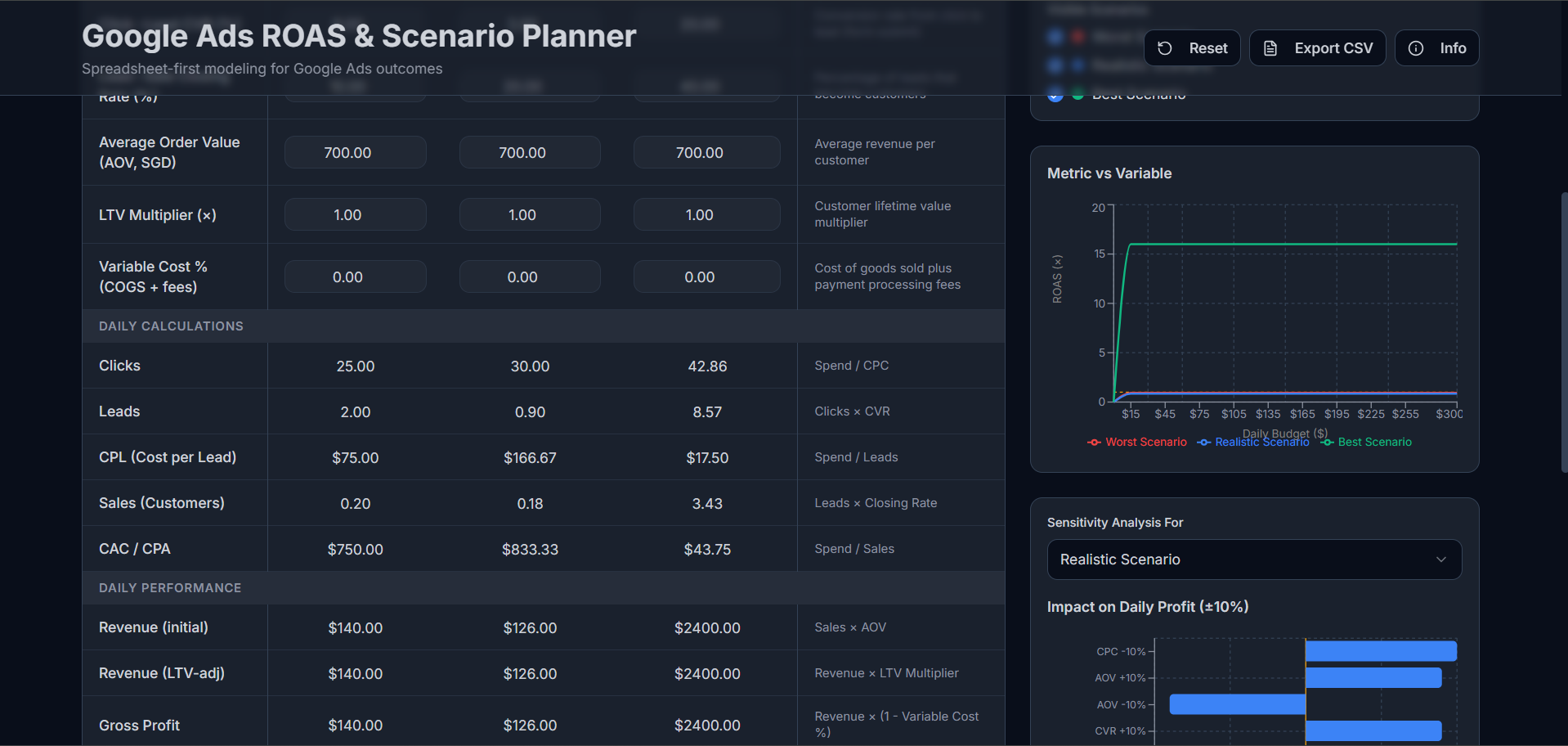
Vary margin, refunds, close rate and acquisition cost independently. Avoid assuming repeat purchases until your own retention records support them. Review mature customer cohorts so the sales cycle does not distort the comparison.
Use the Google Ads planning service to connect the model with tracking and campaign decisions.